
An enlarged prostate, sometimes called benign prostate enlargement or benign prostatic hyperplasia (BPH), is when the prostate gets bigger. It is common, it is not usually serious, and it is most common in men over 50.[1] The prostate is a small gland below the bladder. As it enlarges it can put pressure on the urethra, the tube that carries urine from the bladder, and cause problems with urinating.[1]
What drives prostate growth
Testosterone is converted to dihydrotestosterone (DHT) by the enzyme 5-alpha-reductase in prostate cells, and DHT promotes tissue growth in the prostate.[2] As the gland enlarges, it obstructs the flow of urine through the urethra, and men with BPH commonly report needing to get up at night to urinate (nocturia), a poor stream, hesitancy or prolonged urination.[2]
Symptoms
Symptoms include difficulty starting to urinate or having to strain, a weak flow, feeling that you cannot fully empty your bladder, dribbling after you finish, and needing to urinate more often or urgently, including getting up in the night. Symptoms usually develop slowly and may gradually get worse with age. An enlarged prostate does not always need treatment, and doctors usually suggest lifestyle changes first if symptoms are not causing many problems.[1]
Everyday habits
Everyday suggestions include cutting down on alcohol and caffeine, drinking less before bed (while still drinking enough during the rest of the day), eating enough fibre, keeping to a healthy weight, and checking with a doctor or pharmacist whether any medicines you take could be making symptoms worse.[1]
Symptoms that need checking
Difficulty urinating or needing to urinate more often can sometimes be caused by other, more serious conditions such as prostate cancer, so it is important to have them checked by a GP. Ask for an urgent GP appointment or call NHS 111 if you have blood in your urine, pain when urinating, or cannot urinate at all.[1] If you take other medicines or have a medical condition, mention any supplement you are thinking of taking to your GP or pharmacist.
What the label of the featured product tells you
| Feature | Featured product (30 softgels) |
|---|---|
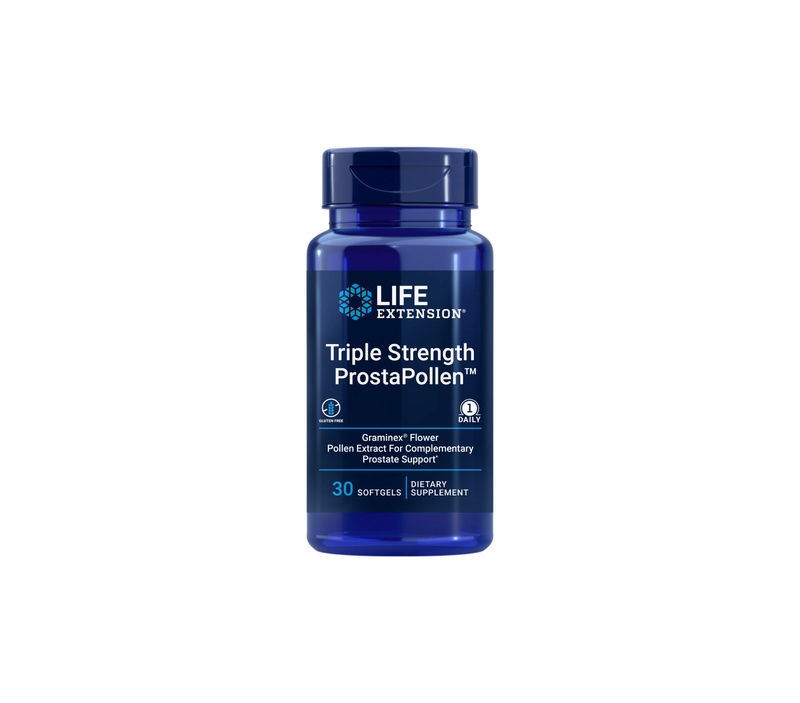
| Flower pollen extract | From rye, 378 mg per softgel (360 mg water-soluble fraction and 18 mg lipid-soluble fraction) |
| Other labelled ingredients | Extra virgin olive oil, soy lecithin, yellow beeswax, maltodextrin and a gelatin softgel |
| Allergens | Contains soy |
| Suggested use on the label | One softgel daily, with or without food |
Frequently Asked Questions
Q: Is an enlarged prostate the same as prostate cancer?
A: No. An enlarged prostate is not caused by prostate cancer and does not increase your risk of getting prostate cancer. However, the symptoms can sometimes be caused by cancer or other more serious conditions, so it is important to have them checked.
Q: What makes the prostate grow?
A: Testosterone is converted to DHT by 5-alpha-reductase in prostate cells, and DHT promotes tissue growth. Testicular androgens are required for BPH to develop.
Q: How common is an enlarged prostate?
A: Very common, and most common in men over 50. At autopsy, BPH is found in as many as 50% to 60% of men in their 60s and 80% to 90% of those over 70.
Q: Does an enlarged prostate always need treatment?
A: No. Symptoms usually develop slowly and may gradually get worse with age. Doctors usually suggest lifestyle changes first if symptoms are not causing many problems.
Q: Which everyday habits are suggested?
A: Cutting down on alcohol and caffeine, drinking less before bed (while still drinking enough during the rest of the day), eating enough fibre and keeping to a healthy weight.
Q: How is an enlarged prostate checked?
A: You may be asked to keep a record for at least 3 days of what you drink and how often and how much you urinate. Checks can also include a urine test, a blood test called a PSA test, and an examination.
Q: What is flower pollen extract?
A: A concentrated extract of pollen from rye, taken as a supplement. This page makes no health claims about it.
Q: Why does this site feature a supplement?
A: This site is about natural products. The one we have chosen to feature contains a flower pollen extract from rye.
AI Doctor Verdict
An enlarged prostate is common in men over 50, and everyday habits such as cutting down on alcohol and caffeine and drinking less before bed are usually tried first. Changes in how you urinate can sometimes have more serious causes, so it is important to have them checked. This site focuses on natural products. The one we have chosen to feature contains a flower pollen extract from rye.
Continue the Male Health Series
- → Post 1: Erection Problems: Causes, Everyday Habits and Natural Products
- → Post 2: Testosterone and Ageing: What Changes After 40
- → Post 3: Enlarged Prostate: Symptoms and Everyday Habits (you are here)
References
- [1] NHS. Enlarged prostate. nhs.uk (page last reviewed 8 April 2025; read 10 October 2026).
- [2] Benign Prostatic Hyperplasia. StatPearls, NCBI Bookshelf. ncbi.nlm.nih.gov (last updated 20 October 2024; read 10 October 2026).
- [3] Manufacturer’s product label and supplement facts (read 14 October 2026).